



7 reasons the Wonder Wall is the last learning toy you'll ever need to buy.
The average toddler receives 70+ toys a year. Most get four minutes of attention. Most end up in a bin, a donate pile, or a corner — with most of the pieces still in the box. This is the story of what happens instead, when you put one open-ended surface on the wall and walk away.

Ages 2–6 are the window.
You can't get them back.
"The brain develops faster in the first five years than at any other point in life. What children do with their hands, their eyes, and their imagination during this window shapes cognitive architecture that persists for decades."
— Developmental research consensus, cited widely in early childhood educationThis isn't alarmism. It's the most well-supported finding in developmental neuroscience. The early years are the highest-leverage years. What children do with unstructured, self-directed time in this window — mark-making, building, sorting, imagining — builds the neural pathways for focus, problem-solving, creativity, and literacy that no structured curriculum can replicate.
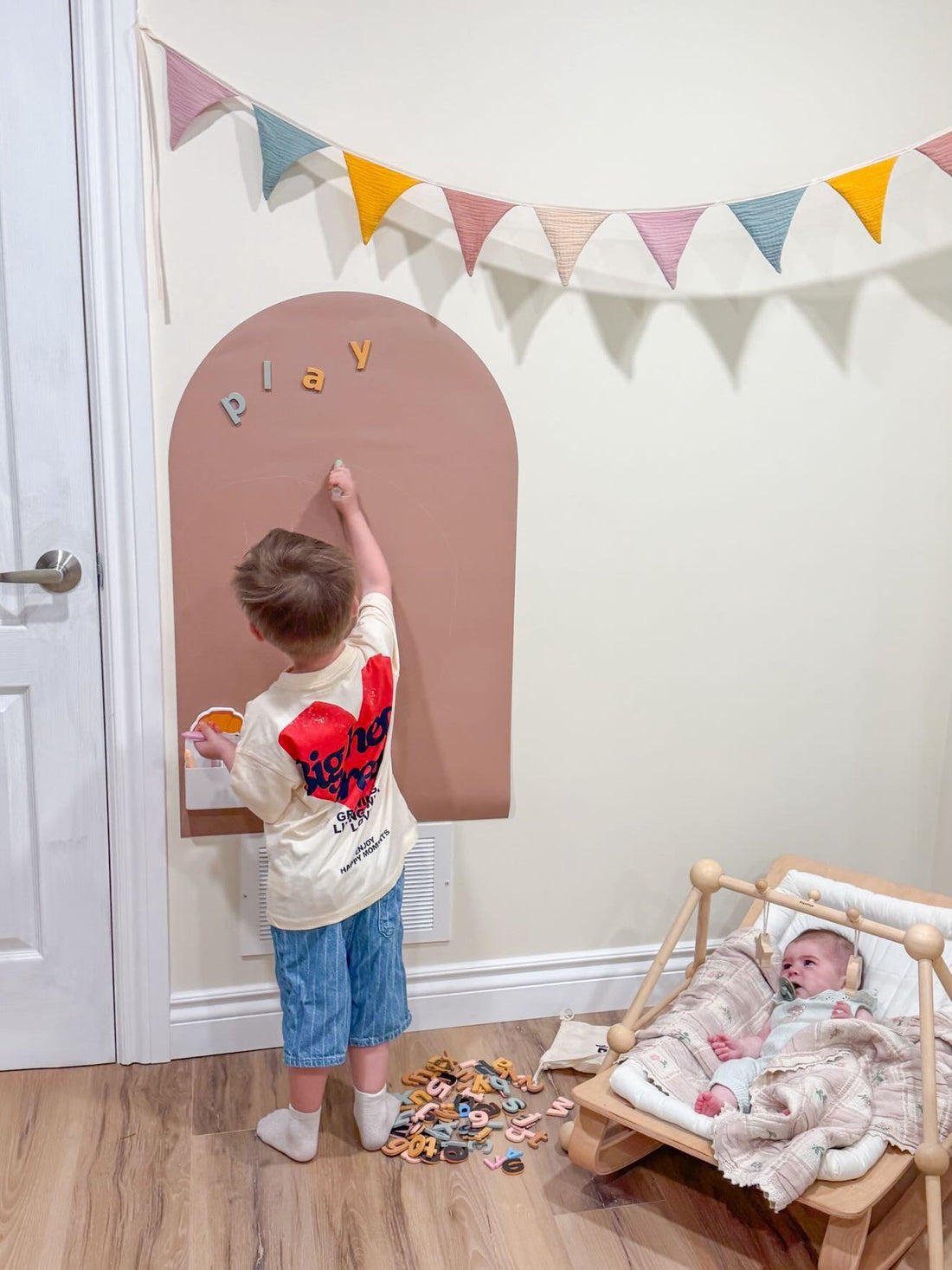
The Wonder Wall is not a toy. It's a daily practice surface. One that stays at their eye level, always visible, always ready — so those unstructured minutes happen naturally, habitually, without anyone having to suggest it.
The most reported time parents first notice their child at the wall. Before the tablet. Before breakfast. Unprompted, every morning.
"I've bought a lot of things that claimed to be educational. This is the only one that actually was. Month four and she still reaches for it every morning — before her tablet, before her toys, before breakfast."
Open-ended surfaces get used for years.
Toys with one answer get forgotten in days.
Here's the simple truth about why most educational toys fail. They have a right answer. A puzzle has one solution. A stacking toy has one configuration. A shape sorter has one correct orientation. Once a child has found the answer, the toy is solved — and the brain moves on.
The Wonder Wall has no right answer. There is no solution to find. A blank magnetic surface with chalk doesn't tell a child what to do — it invites them to decide. And because the decision is always different, the surface never gets solved. It just gets returned to, in a new way, every single day.
"She uses it differently now than she did six months ago. At two, she scribbled. At three, she sorted shapes. At four, she's spelling her friends' names and asking me to check them. Same wall. Completely different play."
— Emma L., Toronto · Verified buyerShe started sounding out letters at 7am.
I didn't teach her. I just put up the wall.
This is the most common unexpected outcome parents report. Not that their child drew on the wall — they expected that. But that the learning happened independently. Without flashcards. Without a lesson. Without anyone sitting down and saying "now we're going to practice letters."
The mechanism is simple. When you add the magnetic letters set, the letters live on the wall at their eye level, always visible, always touchable. Children begin to match shapes, notice patterns, rearrange letters — and somewhere in that play, letters become meaningful. Not because they were taught. Because they discovered.
"She started sounding out letters by herself at 7am. I didn't teach her. I didn't sit with her. I just put up the wall and walked away. She figured it out on her own — completely independently. We added the letters set after the first week and it unlocked a completely different level of play. Now she spells her name, her friends' names, and comes to get me to show me every single time."
"He started building little patterns and narrating them to me. It feels like play. It looks like play. But I can see how much thinking is actually happening. His preschool teacher mentioned unprompted that he was doing better with shapes and colours than the rest of his class. I'm not going to take full credit. But I know what changed."
View the colours, bundles, and today’s offer.
You can keep reading the full story, or jump straight to the gallery and build the set that fits your child right now.
Your walls are safe.
300+ renter orders. Zero damage complaints.
This is the question we get most. And the answer is the most concrete proof we can offer: in over 300 orders to renters, we have not received a single wall damage complaint. Not one.
The Wonder Wall is a high-quality peel-and-stick vinyl decal, designed for painted walls. Remove it slowly, following the included instructions, and it comes off cleanly. No residue, no damage, no drama. Parents who've moved apartments with it up have reapplied it the same day in the new place.
"We're renters and I was genuinely nervous about putting it up. It came off our new place wall perfectly — not a single mark. We moved cities in March and it was the first thing we put up in the new house. Our son walked in, saw it on the wall, and went straight to it. Moved in at 2pm. He was at the wall by 2:15."
— Luke & Amy B. — Montréal · Verified buyersRenter orders shipped. Zero wall damage complaints. Peel it off slowly, following the instructions, and it comes off clean.
It looks like something you chose.
Guests ask where you got it.
Most learning toys are designed for daycares. Bright primaries. Chunky plastic. Maximum visual noise. They're built for durability and child-appeal, with no consideration for the aesthetic of the home they're going into — or the parent who has to look at them every day.
The Wonder Wall is different. Six neutral, intentional colours — Baby Pink, Peach Blossom, Baby Blue, Ink Blue, Slate Grey, Rosewood — chosen specifically for modern homes. The arch shape is architectural. It sits flat to the wall. It looks deliberate. It looks like something you chose for the room, not something you tolerated for the child.
"I've spent so much money on toys that end up in a bin. I didn't want rainbow plastic taking over our living room. The Wonder Wall actually looks like something we chose for our home. Guests always ask where I got it. Not 'is that for your kids.' Just: where did you get that?"
The play compounds.
Every week, something new.
This is the thing no toy catalogue will tell you: the most valuable play is the play that evolves. Not the play that entertains — the play that changes as the child changes. That challenges them at two and still challenges them at five.
Here's what the Wonder Wall progression actually looks like:
"Setup took maybe three minutes. And then she just… found it. No instruction. No introduction. She walked up to it, picked up a piece of chalk, and started drawing. Like it had always been there. Like it was always hers. That was eight months ago. It's still the first place she goes when she wakes up."
The only risk is not trying it.
We believe in the Wonder Wall because we see what parents tell us, week after week. But we also know that belief doesn't pay for a purchase. So we've taken all the risk off the table.
Bring it home. Watch your child use it for 30 days. If for any reason it isn't the right fit — you don't love the colour, it doesn't stick the way you expected, your child ignores it completely — contact us and we'll make it right. Full refund. No forms. No return shipping. No questions.
Full refund. You lose nothing except a little time.
She's at the wall at 7am. For months. For years.
Everything you need, without the guesswork.
Pick the Wonder Wall colour that fits your home, then add the magnetic play pieces that match your child’s stage. Free chalk is already included — no code needed.
Everything you need
in one order.
Pick your colour. Add the play pieces that make sense for your child right now. Free chalk is already included — no code needed.
A learning wall
that grows with them.
A flat-to-wall magnetic + chalk-ready surface for mark-making, shapes, letters, number play, and open-ended creativity.
Free shipping · no surprise duties · free chalk set included
Choose the shade that fits your playroom.
Wall + free chalk.
Add the play pieces.
Magnetic. Chalk-ready. Dry-erase. Start with the Wonder Wall, then add the accessories that make it independent play.

Shapes, sorting, patterns & spatial play — easy independent activity.

Name spelling, early literacy & number play — right on the wall.
Made for real homes: no drilling, no bulky easel, no playroom remodel.
★★★★★ "It became her first stop after breakfast."
Secure checkout · free shipping · duty-free to Canada & the US.
P.S.
The early years are short. They go faster than anyone warns you. The Wonder Wall won't teach your child for you — but it gives them a surface to teach themselves. A place they return to. A habit of making, building, spelling, imagining. The parents who've bought it don't regret it. The ones who didn't — and watched another year pass with a tablet in their child's hands instead — often wish they had.
— Bambi Haus. Made by a mom who couldn't find what she was looking for.